
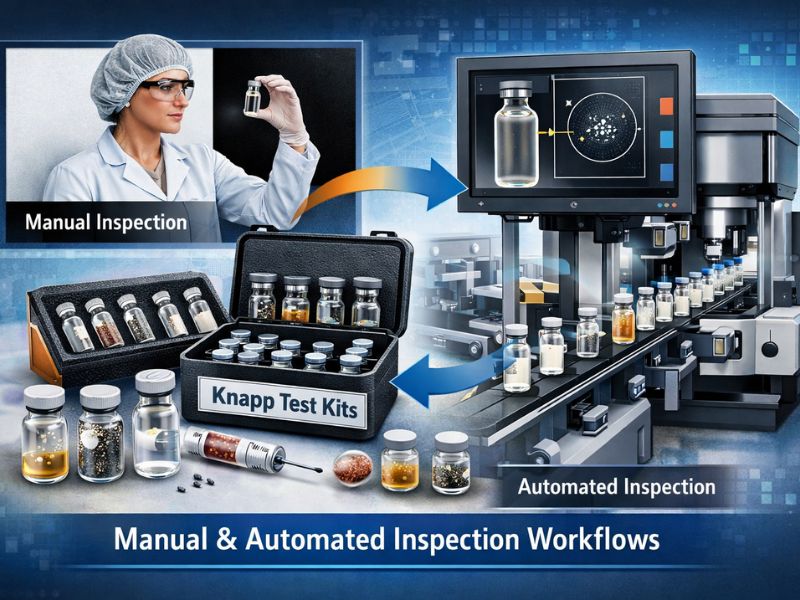
Introduction – Visual Inspection as a GMP Control Point
In sterile manufacturing, 100% visual inspection of every container is mandated by GMP standards. Pharmacopeias (USP, Ph. Eur., JP) require that final products be “essentially free” of visible defects through validated inspection processes. This means each vial or syringe is examined under specified conditions (alternating black/white backgrounds, 2,000–3,750 lux illumination, no magnification). Any unit showing a particulate or container flaw must be removed. The regulatory agencies view 100% visual inspection as a critical quality control parameter which is critical, but essential to assure patient safety. To achieve 100% visual inspection criterion, manufacturers adopt systematic processes and Knapp test kits to qualify the human inspectors and automated visual inspection systems.
Applications of Visual Inspection Kits (VIKs) in Qualifications
Visual Inspection Kits (VIKs) or Knapp kits are sets of products filled containers seeded with known defects which are essential to qualify visual inspection systems. These Knapp kits contain certified defects which are used to train and certify human inspectors and automated visual inspection systems, ensuring that each container reaches an acceptable probability of detection (PoD) for relevant defects. For example, USP <1790> stipulates that any automated alternative must demonstrate detection performance “equal or better” than qualified manual inspection. In fact, a recent industry guide notes that an AVI system “must pass a Knapp test”, to validate that its accuracy is at least as good as a human inspector.
Global regulatory agencies expect manufacturers to document all activities related to qualification of MVI or AVI systems. USP <1790> and draft Annex 1 guidance emphasize using calibrated defect standards and performance studies to justify any inspection method. For automated inspection, this means using kits during Factory and Site Acceptance Testing (FAT/SAT) and Performance Qualification (PQ) to prove Probability of Detection (PoD) and acceptable False Reject Rates (FRR) under realistic conditions. In both manual and automated workflows, defect libraries (image libraries or physical kits) are used to verify that detection logic is tuned correctly. In short, Knapp kits provide the standardized challenge cases that tie together regulatory requirements and real-world inspection performance.
MVI (Manual Visual Inspection) system Work flows
In a MVI station, well-trained inspectors examine each container against alternating black and white backdrops at ~2,000–3,750 lux. Inspectors gently invert or swirl the vial so that any concealed particulates rise and become visible. Under USP <790>/<1790> guidance, this movement is key to detection – it flushes particles off inner walls into view. Inspectors typically spend about 5 seconds viewing against each background (≈10 seconds per unit). During qualification studies, this timing is enforced, guidelines suggest aligning test rate with routine pace (e.g. ~3–4 units per minute). (In practice, companies often record inspection batch times to verify this rate.)
Operator factors are equally important. Inspectors must meet vision standards (20/20 near acuity, normal color vision) and receive extensive training. USP <1790> recommends a phased program, begin with defect photos or video libraries under expert mentorship, then progress to hands-on inspection of seeded kits. Trainees learn consistent pacing (e.g. silent counting) and strict adherence to procedure. Training covers a range of defect types and sizes (100–500 μm particles, fibers, colored or transparent) representative of the product’s rejects. Inspectors are even tested under fatigue conditions (e.g. at the end of a work shift) to ensure robustness. Breaks are mandated – for example, giving inspectors a ~5-minute rest every hour – to combat eye strain and fatigue-related misses. All inspection groups (QC, QA, production) use a unified SOP to ensure consistency.
Inspector Qualification and Tracking – Before licensure, each inspector must successfully identify a range of seeded defects. A recommended criterion is three consecutive passes of a blinded test set under normal shift conditions. Acceptance criteria are defined per defect class based on measured PoD, with a target false-reject rate (FRR) kept very low (typically <5%). For example, USP guidance notes that FRR should not exceed 5% during qualification. These measures ensure an inspector isn’t overly conservative (rejecting too many clean units) or too lax. Performance is recorded on PoD evaluation sheets (tracking each inspector’s hit rate on standards), helping QA to monitor skill retention over time. In practice, manual kits containing realistic defect standards (e.g. tiny glass shards or fibers) yield far more reproducible training results than idealized spherical beads, because they “better represent actual inspection performance”. In short, by practicing on Knapp kits, human inspectors calibrate their vision to real worst-case scenarios, reducing variability and false negatives across shifts.
Automated Inspection Workflows
Automated vision systems replace human eyes with cameras and algorithms, but they too rely on Knapp principles. Automated stations use precisely aligned cameras, stable fixtures, and synchronized lighting to capture clear images of each product. Pre-processing often includes a pre-spin step, for example, rotary conveyors spin vials to lift hidden particles into suspension. Then, multiple cameras (top, bottom, side) photograph each container under optimized lighting. Different lighting modes are used to highlight defect classes, e.g. backlighting silhouettes floating particulates, dark-field lighting reveals scratches or bubbles, and diffuse lighting minimizes glare for cosmetic flaws. These engineered lighting conditions, combined with controlled camera exposure and synchronization, create “a perfect, repeatable image” for analysis. In essence, every imaging variable (focus, exposure, contrast) is tightly controlled so that defects stand out and false rejects are minimized.
- Camera Calibration & Validation Kits – Physical calibration kits are used to tune the hardware. The calibrated defect samples are present in Machine Calibration Kits, which enable engineers to adjust lighting intensity, camera focus and software sensitivity. By scanning these calibration units with the machine, one can align and optimize the system’s settings to detect particles at the desired size threshold. Functional Kits (with easy-to-see defects) verify proper camera alignment and conveyor setup after installation or format change. In short, calibration kits ensure the system is physically set up to see particles reliably.
- Qualification (FAT/SAT) and Re-Qualification – During equipment commissioning (FAT/SAT), certified Knapp test sets are run to prove compliance. Performance Qualification Kits (PQ Kits) contains a calibrated known defects covering all categories like fibers, particles, cosmetic defects and closure flaws. PQ kits are used to ensure that the AVI system meets defined PoD targets while keeping false rejection at the lowest possible. Nishka Research, which is a pioneer global Knapp kits manufacturer explains that their kits ensure AVI systems “meet PoD requirements while minimizing false rejection rates,” supporting regulatory compliance. It is recommended that, manufacturers should schedule regular revalidation runs using the kits to catch any deviations in performance. For instance, guidelines suggest re-running test sets annually and any time the system shows poor performance. Such ongoing checks help maintain confidence that the automated inspection is as robust as its initial qualification.
Industry-Specific Applications
- Biotech (Proteins/Aggregates) – Biologics present unique challenges, protein therapeutics can develop transparent, gelatinous aggregates that are harder to spot. Inspection kits for biologics often include protein-like particles to simulate these scenarios. In fact, NIST and industry groups are developing reference standards (e.g. polymer particles) that mimic visible proteinaceous contaminants. Using such specialized kits helps ensure inspectors (or cameras) recognize protein aggregates or fibers as defects. Kits may also account for the often amber/orange coloration and opalescence of biotech solutions, which can mask particles. Incorporating relevant defect types into kit test sets makes detection training and qualification more representative of real biotech products.
- Ophthalmics (Eye Drops/BFS Containers) – Topical eye products (drops, ointments) are typically in opaque or semi-transparent dropper bottles. USP <771> now instructs that these products undergo particulate inspection as if they were injections. But practical constraints (opaque plastic, tiny volume) make 100% inspection of each filled bottle impossible. Instead, the industry uses an alternate approach, statistically sampling the batch and performing destructive tests (e.g. filtration of lots of units) against acceptance criteria based on process capability. In other words, small samples or “wet chemistry” is used in place of visual checks. For blow-fill-seal (BFS) ampoules often used in ophthalmics, kits are designed differently, because of the fast-emptying, low-viscosity liquid and minimal headspace, kits may use fillable BFS surrogates with seeded defects on the glass. Specialized BFS kit standards exist to reflect the ultra-clear, low-volume nature of these containers. In all cases, the emphasis is on demonstrating that the manufacturing process controls (and any sample tests) effectively limit particulates, since direct visual inspection of each unit is not feasible.
- Generics (High-Volume, Mixed Formats) – Generic drug lines often run many products and container types on shared equipment. For Mix and Match production the Knapp kits should also be complaint and fit for any types of containers. Best practice is to develop separate test sets for each unique formulation/container combination produced. For example, clear-vial solutions, amber-vial suspensions and lyophilized powder vials would each have their own set of challenge vials with appropriate defects. Regardless of product type, the kits must be customized to the defect profile and visibility challenges of each category, whether that’s protein clumps in a biologic product, fine glass flakes in a generic solution or hair fibers in an ophthalmic product.
SOP Integration and Audit Readiness
Knapp kit usage should be explicitly documented in SOPs for regulatory inspection. SOPs must describe when and how kits are used (initial qualification, requalification, calibration, training drills) and who is responsible like QC analysts, engineers or QA reviewers. For example, a test-set creation SOP should define Keeping a running log of kit qualification criteria, storage conditions, periodic examination and requalification intervals, expiration dating and inventory control. During an audit, regulators expect to evaluate this documentation, for instance, the USP guidance notes that test kits should be reviewed and approved by QA and assigned a shelf-life usually 12 to 18 months.
Industry practices include cross-referencing the kit procedures in the main Visual Inspection SOP and maintaining complete records of kit serial numbers or IDs, training completion and PoD results. Inspectors’ training logs and qualification test records (showing detection hits/misses on kit standards) must be organized and available. Keeping a running record of kit results and equipment performance checks helps demonstrate compliance. As one kit manufacturer puts it, visual inspection kits are designed to “support regulatory compliance testing in accordance with USP <790>, <1790>, EU GMP and other global standards”. In general practice, audit readiness means you can quickly produce inspector training records, PoD evaluation sheets, machine qualification logs and SOPs, all evidencing that kits were used correctly.
Constant Improvement
Visual inspection is inherently probabilistic in nature, inspectors or machines may occasionally miss a defect. Therefore, it is essential that continuous process improvement is to be followed from time to time. Any defect encountered should trigger a mechanism that should include feedback loop, root-cause analysis, Corrective and Preventive Action (CAPA) and update to training or equipment settings. In practice, teams should regularly trend reject data and defect types. Regulators also emphasize trending, a recent industry case study on ophthalmics noted that an inspection program should include “historical trending; process monitoring; and upstream controls” to meet GMP expectations. Annex 1 even calls for trending of visual inspection results as part of its revised requirements. Human inspectors and AVI systems can be benefited from periodic requalification. Human inspectors should undergo formal retraining at least annually irrespective of performance issues and mandatorily if performance issues are identified. Knapp Kit should be periodically reviewed and refreshed as per SOP schedule. Most subject matter experts (SMEs) recommend inspecting test kit units and renewing them yearly. For instance, a set might be given a one-year expiration, after which each container is rechecked for an intact seed defect and the kit is re-certified. Documenting this kit lifecycle (exam dates, replacements, etc.) ensures that standards remain reliable. In this way, annual retraining and kit maintenance together close the loop of calibrating both people and machines to an evolving production process.
Conclusion – Knapp Kits as a Quality and Efficiency Enabler
Visual inspection is a linchpin of injectable quality, and Knapp kits are the tools that make it practical, reproducible, and auditable. By providing known defect challenges, these kits synchronize manual and automated workflows, inspectors and cameras are held to the same benchmarks. They streamline qualification, unify training, and help meet GMP expectations from initial qualification through ongoing operation. In deploying Knapp kits, pharma operations gain both assurance and efficiency – enabling confident 100% inspection that consistently protects patient safety while satisfying regulators’ requirements.
FAQ’s
Can one Knapp Kit be used for both manual and automated inspection?
Often no. Nishka Research typically recommends separate but harmonized kits, ensuring both human inspectors and machines are challenged appropriately under their respective inspection conditions.




0 Comments