
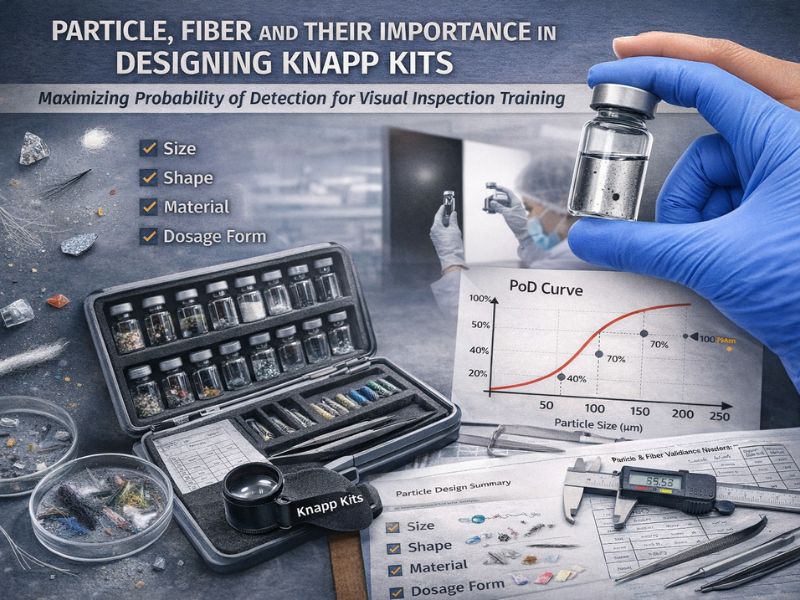
Ensuring 100% Visual inspection of sterile products is mandated by almost all regulatory agencies with their respective pharmacopeial and GMP standards. This can be achieved by training and qualifying the visual inspectors using Knapp Kits or challenge kits which are set of standard defects. These kits are made of representative particles and fibers to simulate the real-world contamination. In routine and regular practice, each fiber or particles detectability is dependent on this size, color, material and container. Regulatory guidelines (USP, EMA, WHO, etc.) even require inspectors to be trained using “defect library” sets under controlled lighting and background. In other words, carefully engineered particles and fibers are the heart of a Knapp kit’s effectiveness. This post dives into how size, shape, material and dosage form influence particle visibility, and how to design kits that maximize Probability of Detection (PoD) for inspector training.
Particle Size Design
Visual particle detection is inherently probabilistic – there is no single “cutoff” where a particle suddenly becomes visible. Traditional guidance (USP <790>, Ph. Eur., etc.) assumes a nominal lower limit around 100 µm, but in reality much depends on context. A recent FDA draft guidance emphasizes that threshold studies must be done to determine the smallest particle size a trained inspector can consistently detect. Indeed, empirical studies show a sharp PoD curve with particle size. For example, one analysis under ideal conditions found that a 50 µm particle (the approximate lower visible limit for 20/20 vision) is hardly seen – only ~4% probability of detection (PoD). Detection rises to about 40% at 100 µm and ~70% at 150 µm, reaching over 90% by 200 µm. In practical terms, this means 50 µm particles are effectively sub-visible, 100 µm are seen less than half the time, and around 150–200 µm are needed for reliable detection. (For context, USP <788> defines subvisible particles as those under 100 µm.)
This PoD curve has led to common misconceptions: for instance, some assume a 50 µm inclusion can be detected like a speck of dust. In fact, only exceptionally high-contrast particles can be seen at 50 µm. A colored or dark particle on a bright background might pop at ~50 µm, but a transparent or white particle of the same size will be virtually invisible. Likewise, a 100 µm particle is often thought “visible,” yet inspectors may only spot ~40% of such defects. It is only as particles grow toward 150–200 µm that detection becomes robust (~70–95% PoD). (As one team noted, by ~200 µm nearly all particles are caught.)
In practice, Knapp kits should therefore include a range of sizes across the practical detection threshold. Very small test particles (~50–100 µm) ensure inspectors practice finding marginal defects (though with low PoD), while larger particles (≥150 µm) verify the high end of detection. Typical kit design tips are to use spheres ≥100 µm and fibers ≥500 µm so that at least some chance of detection exists. Regulatory chapters reflect this reality: USP <790> calls for 100% inspection and rejection of any visible defect (assuming ~100 µm lower bound, though acknowledging variation), and Informational USP <1790> similarly encourages practical inspection qualification methods. EMA Annex 1 (and WHO sterile GMP Annex 2) explicitly require inspector qualification “using defect library sets… considering worst-case scenarios”. Taken together, these references stress that inspection programs must assume the visible range is broad and train on realistic defect sizes.
Probability of Detection (PoD) Curve – A graphical chart of PoD vs. particle diameter is invaluable. It typically shows near-0% detection at 50 µm, ~40% at 100 µm, ~70% at 150 µm, and ≈100% by 200–250 µm. (Such a chart can be downloaded as a reference for kit design.) In short, kit designers should employ particles spanning this curve so inspectors confront marginal and easily visible defects alike.
Fiber Type and Characteristics
Fibers present unique challenges compared to equant particles. The visibility of a fiber depends less on diameter (typically on the order of 20–50 µm for most threads) and more on length and orientation. As one study notes, a standard visual check “only consistently detects particles about 100 μm, and fibers typically have to be much longer to be detected”. In practice, fibers often need to be several hundred micrometers long before a human eye flags them. (In fact, kit suppliers advise using fibers ≈0.5–1 mm long to ensure any chance of detection.)
The material and color of a fiber also matter. Synthetic fibers (PES polyethersulfone, PTFE Teflon, nylon) are often white or translucent, and may reflect or refract light weakly, making them less conspicuous than opaque fibers. Cellulosic fibers (cotton, paper) are usually off-white and diffuse light more readily, improving visibility. Human hair, being pigmented and sometimes thicker (tens of microns), is one of the most obvious fiber contaminants. In a kit context, one might include white cotton fibers to mimic lint, clear Teflon to simulate tubing shavings, and dark hairs for high-contrast defects. Varying colors (e.g. black vs. white fibers) against the container background ensures a range of detection conditions.
Fiber orientation is critical. A long fiber floating end-to-end across the field presents a visible line; if it lies parallel to the viewing direction, only its thickness shows (often invisible). Curvature and static can cause fibers to drape along walls: a fiber stuck on the vial wall might appear as a fine line or even vanish into reflections. In practice, kits often place fibers diagonally or partially adhered so that at least part is visible through the liquid. In blow-fill-seal (BFS) containers, the thin plastic walls can cause fibers to cling electrostatically; fibers in a BFS kit may be oriented to simulate this effect.
Key fiber tips for kit design: – Use several fiber types (PES, PTFE, cellulose, hair) to mimic extrinsic vs. intrinsic contamination.
– Ensure lengths well above 250–500 µm (uncoated kits typically recommend ≥500 µm for any detectability).
– Employ high-contrast coloring (e.g. black/cotton) and vary orientation so part of the fiber spans the visual field.
– Note that OSHA guidance and inspections often find that fibers are only flagged when quite long, reinforcing the need for very long fibers in training kits.
Material science of particle
During visual inspection, the particle behavior is dependent on material’s composition. This behavior is majorly dependent upon Optical and reflective properties.
Exemplary representation of MOC with respective to particle and level of detection
Buoyancy and Density are the typical parameters of particle which will where the particle has to be settled, sink to the bottom of a vial or accumulate at the base of a syringe. If inspection starts at the top post inversion, heavy particles may settle at the bottom, which might be out of view, leading to false negative results. Lighter particles like fibers, plastic and beads may float or drift. These important parameters has to be considered while designing the Knapp kit, where deliberately we place heavy particles to settle down to bottom while few light particles are added as floating defects so as to simulate both conditions. There by inspectors will be well-trained for efficient detection of defects.
Cling and orientation – Some particles tend to stick to surfaces. Hydrophobic powders or silicone residues can cause particles to cling to container walls. For instance, a small glass shard might adhere to the inside wall of a vial, especially if there is condensation or silicone oil film. Such adhesion can make a defect very hard to see unless the container is rotated into a favorable view. Conversely, some particles form visible agglomerates: e.g. silicone oil droplets (from syringe manufacturing) can coalesce with other debris and grow large enough to see (important in prefilled syringe contexts, below).
In summary, material science effects mean that kit designers should include a variety of materials and colors. Inspectors must learn that a dull gray flake on a white background is not as obvious as a shiny aluminum piece on a black background. By mixing metals, glass, and plastics of different hues and reflectivities, a kit can challenge visual inspectors in realistic ways. (As USP notes, the visible detection limit “varies depending on… particulate matter properties (color, shape, refractive index)”.)
Dosage Form-Specific Considerations
Different containers pose different inspection challenges. Respected Knapp kit suppliers will consider all these challenges while designing the customized visual inspection kits or Knapp kits.
- Injectable Vials: Vials made of plastic or clear glass allow 360° viewing, but also have “blind spot.” Particles at the bottom may be hidden when inspected from above and particles trapped under the rubber stopper or in the neck may be missed. Kits for vials often position test particles in various locations: a heavy glass flake sitting on the bottom, a fiber near the mid-wall, or a speck trapped at the stopper. Inspectors must be trained to invert, rotate and swirl vials under a light source. Special attention should be given to the space under the plastic flip-off cap and rubber seal, as torn rubber or laminated glass fragments can collect there. Moreover, vial kits should mimic common vial fill conditions – for example, if vial volumes are small in production, use appropriately scaled fill. In all cases, standard inspection backgrounds (black/white cards) and luminance levels (as per compendia) should be used for consistency.
- Opthalmic Formats: Eye-drop bottles and single-dose ophthalmic vials (often small polyethylene droppers or glass ampules) require extreme vigilance, as any particulate can harm the eye. These containers are typically clear plastic or glass with narrow nozzles. Because drops are dispensed one by one, even a tiny obstruction in the tip is critical. Knapp kits for ophthalmics often incorporate tiny fibers or dots at the tip and in the reservoir. Inspectors must learn to hold the bottle at both end-on and side-on angles, and to remove or peel back any secondary packaging or droppers to inspect properly. In practice, kits use particles consistent with USP <789> and <790> testing (e.g. neutral glass beads or dark polymer specks) to simulate “worst-case” scenarios. The goal is to train that everything is checked: from the eye-dropper head to the cap threads. (Note: USP <789> sets limits for ophthalmic particulates, but visual inspection per <790> still requires manual training with relevant defects.)
- Blow–Fill–Seal (BFS) Ampoules and Bottles: BFS containers (formed from plastic in a single process) differ in optical properties and handling. The thin walls of a BFS bottle can distort light, and static charge from the plastic may make fibers cling to the walls. BFS units often come in small sizes (1–5 mL), so particles are confined to a shorter vertical column. Kits for BFS usually simulate the machine-controlled fill: containers might be mounted on conveyor cards and inspected at fixed angles. Test particles in BFS kits often include very bright or dark specks against the translucent plastic, since typical BFS filling lines detect opacities automatically. Additionally, because BFS ampoules usually have minimal headspace, any gas bubbles or precipitates (e.g. protein clumps) are trained on. Color vs. background matters here too – for example, a white aluminum oxide particle in a clear BFS bottle looks very different than in a glass vial. While specific guidelines for BFS are evolving, the strategy is to match the container shape and expected defect types (e.g. plastic shavings vs. glass from components) in training kits.
- Prefilled Syringes (PFS): Syringes introduce lubricant and geometry factors. Modern glass PFS are siliconized (for plunger lubrication), so silicone oil droplets are a frequent source of visible “defects.” In fact, excess silicone on the inner walls can form droplets or slick films that capture other particles. A Knapp kit for syringes should include simulated silicone “sheens” – tiny beads or smears – as well as fibers and particles. The long, narrow shape of a syringe means inspection is done differently: inspectors often rotate the syringe while holding the plunger. Particle behavior is also distinct: fibers and debris may lodge along the inner lumen or at the glass-plunger interface. Kit designers sometimes affix test fibers to the plunger or include tapered tips to train inspectors on checking the thin end. Importantly, the plunger and black rubber rod can obscure particles; training kits may use contrasting plunger colors or marked lines to highlight issues. As one presentation notes, any silicone should be minimized because it can “coalesce and agglomerate with other particles, reaching a visible size” – a phenomenon inspectors must recognize.
Custom Kit Design Logic
Designing an effective Knapp kit is a risk-based exercise that balances regulatory requirements, known contaminants, and inspection realism. The following logical steps are often used:
- Identify Likely Contaminants – Gather historical defect data and materials from your process. This includes intrinsic particles (from process equipment or product – e.g. glass flakes, metal wear, rubber bits) and extrinsic contaminants (from the environment or human contact – e.g. hair, gown fibers, dust). For instance, if wire brushing or cutting is done nearby, metal shards might be prioritized; if wipe fabrics are used in clean areas, polyester or cotton fibers are targeted. (If no library exists, some suppliers offer particle ID analysis to seed the kit.)
- Select Particle Sizes – Based on PoD curves, include sizes around 100–150 µm (spheres) and very long fibers (≥500 µm). USP <1790> notes challenge kits should be mostly defect-free (≈90% “blank” units), so only a minority of test units carry defects. Within those defect units, vary size: one test vial might hold a 150 µm glass sphere, another a 75 µm fiber, another a 200 µm plastic flake, etc. This ensures inspectors face a realistic distribution of challenges.
- Choose Materials and Colors – Reflect real conditions. Use clear vs. colored particles to mimic transparent vs. pigmented debris. For example, add black particles or dyes for low-contrast catches, and white or brightly colored beads for high-visibility checks. As one brochure notes, custom kits often offer “different colors” of particles and fibers to match the inspection background. Color contrast tips: a dark particle on a light background is easy to spot, whereas a beige particle on an amber vial is deliberately harder – train both. Similarly, include dense (metal, glass) vs. buoyant (plastic, polymer) particles to test both bottom- and top-screening.
- Vary Fiber Types – Include PES (polyester), cellulose, and hair to represent typical fibers. If the product is syringes with silicone oil, also use fibers that mimic silicone threads (fibrous silicone sometimes appears as stringy particles). Pay attention to fiber length and orientation: many kits provide “≥250 µm” fibers but a recommended practice is to use even longer ones (≈1 mm) so they are at least theoretically visible.
- Simulate Container Effects – Match the kit to each container closure. For example, in vials use blank vials identical to production (same color, volume). Add test particles with the same technique (e.g. insert into stopper, or drop in last). In syringes, apply silicone droplets or paint a thin film of glycerin to mimic lubricity issues. For BFS, charge the internal surface or use an antistatic agent to simulate how fibers might cling. Always ensure test units are inspected in the same way as real products (e.g. under the same lighting (2000–3750 lux) and timing protocols).
- Document and Validate – Record the specifics of each test unit (particle type, size, location) and have inspectors qualify using these. Periodically review and update the kit based on any new process changes or emerging contaminants. Maintain traceability and consistency (USP <1790> urges full traceability of training kits).
Throughout, keep contrast and density in mind. A useful trick (from industrial research) is to inspect a vial against both black and white backdrops. Black backgrounds make light/white particles pop, while white backgrounds help catch dark particles. Kits may include reference images or tables (for example, a “Particle Design Summary Chart” plotting size × material × expected visibility) to help trainers calibrate challenge difficulty.
Conclusion – Making Science Meet Compliance
Knapp kits bring together optical physics, material science and regulatory rigor. By carefully engineering the size, shape, material and color of particles and fibers, kit designers create realistic challenges that mirror the actual risks in sterile manufacturing. This science-driven approach directly improves inspector training: realistic defect libraries increase inspectors’ actual Probability of Detection (PoD) for subtle defects, ultimately protecting patients. At the same time, it satisfies “compliance” – global regulators now explicitly expect visual inspection programs to be qualified with defect sets and performance-tracked.
In short, effective Knapp kits are a perfect example of science meeting compliance. They use data (contaminant size distributions, PoD studies) to design test units, while aligning with USP, EU/Annex 1, WHO and FDA guidance that demand robust qualification. Industry guidance increasingly converges internationally: from USP chapters <790>/<1790> to EMA Annex 1 to WHO sterile GMP, all emphasize the need for 100% inspection and qualified personnel. By following these principles, QA/QC leaders and audit teams can ensure that their visual inspection training truly reflects the real-world defect spectrum – making kits that are both scientifically sound and audit-ready.




0 Comments