
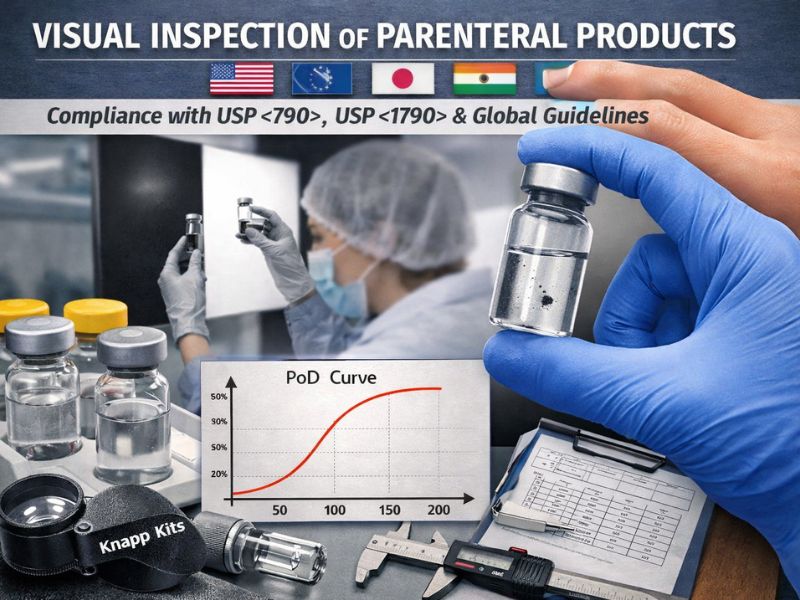
Visual inspection of parenteral products is a critical regulatory requirement worldwide. Standards like USP <790> (“Visible Particulates in Injections”) and USP <1790> (“Visual Inspection of Injections”) codify how manufacturers must inspect each container for visible defects. These chapters define key terms, describe inspection procedures (lighting, backgrounds, handling, timing), and mandate rigorous inspector qualification. Across regions, agencies (FDA, EMA, WHO, PMDA, CDSCO, etc.) expect companies to follow these guidances and demonstrate inspector competency using calibrated test kits and Probability of Detection (PoD) data. This post unpacks those regulatory foundations and shows how Knapp Kits align with global expectations for visual inspection.
USP <790> and <1790>: Key U.S. Pharmacopeia Requirements
Visible particles. USP standards treat visible particulates (also called particulate matter) as “mobile, undissolved particles, other than gas bubbles, unintentionally present in the solution”. In practice, this means any solid fleck or fiber seen in a filled vial should be considered a defect. USP <790> explicitly requires 100% inspection of each filled parenteral container. FDA slides summarizing USP note: “Each final container… should be inspected to the extent possible” and if visible particulates are seen, “every container… must be rejected”. In other words, there is no “acceptance” of known visible debris — any contaminated unit is discarded.
Inspection conditions – lighting & backgrounds. USP <790> harmonizes with EP and other pharmacopeias. It mandates inspection under bright, uniform illumination (typically 2,000–3,750 lux) against contrasting backgrounds. Inspectors should view each container against black and white panels to maximize contrast and reveal both light and dark particles. (India’s Schedule M similarly prescribes diffused light and white/black backgrounds for glass vials.) Magnification is not usually allowed for routine inspection – only the naked eye under clean lighting.
Container handling – swirl and inversion. To expose any clinging particles, USP guidance advises a gentle swirl or 90° inversion of each container during inspection. The act of swirling or inverting (at roughly 1 revolution per second for ~2 seconds in each orientation) “rinses any particles from the upper inner surfaces” and makes them mobile for detection. Importantly, inspectors must use techniques that avoid introducing bubbles (which can be mistaken for particles). Consistent handling and presentation help ensure all sides of the container are checked. A holding device can help align multiple vials, but carrying too many at once hinders a full view.
Inspection timing – USP <790> specifies a minimum reference time of 10 seconds per container to inspect fully. Concretely, 5 seconds should be spent observing against each of the two backgrounds. Larger or complex container systems may require even more time. Studies show that beyond this baseline, increased time yields diminishing returns, so 10 seconds is considered enough for a reasonably clear product. In practice, companies often use a pacing device (light or tone) to maintain a consistent inspection rate.
Defects beyond particulates – While USP <790> targets particles, inspectors should also watch for other critical defects during the same 100% inspection. These include container cracks or chips, seal defects, incorrect fill levels, and cosmetic flaws. For example, USP <1790> notes container motion can also reveal small cracks or chips. Any nonconformance that could affect sterility or integrity must trigger rejection or investigation.
Inspector qualification and PoD logic – USP <1790> (alongside USP <1> for parenterals) focuses on how to implement <790> in a controlled way. It emphasizes that visual inspection is inherently probabilistic: detection depends on particle size, clarity, background, and human factors. Therefore, USP <1790> requires structured training and qualification of inspectors, plus use of standardized test kits to measure performance. In practice this means defining each inspector’s Probability of Detection (PoD) for seeded defects. Typical guidance is to gather threshold studies across particle sizes (~100–500 µm) and ensure each defect class has an acceptance criterion based on PoD.
In USP practice, inspectors qualify by inspecting a test set of vials containing certified defects. USP guidance recommends using a kit of a few hundred units (e.g. 300–500 vials) seeded with ~10% defective units. The kit should reflect the actual container and formulation. During qualification, an inspector must achieve three consecutive perfect inspections of the kit (i.e. correctly identify all defects) to initially qualify. The process measures PoD or rejection probability (often via the Knapp R<sub>ZE</sub> or similar method) and sets acceptance criteria accordingly. A useful metric is limiting false-rejects of good units – regulators expect this “false reject rate” to be low (typically ≤5%).
Inspectors are requalified at least annually (or after long absence) using a similar test set. Performance records, PoD charts, and test kit certificates are maintained as proof of competency. In short, USP <1790> turns visual inspection into a validated process by quantifying human performance.
FDA Expectations: Pre-Approval and GMP Inspections
The FDA reinforces and extends USP requirements through its guidance on visible particulates. The 2022 draft guidance “Inspection of Injectable Products for Visible Particulates” stresses a risk-based, holistic control strategy. Importantly, it clarifies that merely meeting USP <790> is not enough to automatically satisfy CGMP – companies must also show effective process controls and investigative actions beyond compendial compliance.
Probability of Detection (PoD) Curves
FDA explicitly notes “visual detection is a probabilistic process” that depends on product and particle characteristics. The guidance therefore advises threshold studies: deliberately seed particles of known sizes into sample vials, and determine the smallest size reliably detected by inspectors with normal vision. In practice this produces PoD curves: e.g., one study shows ~0% detection of 50µm spheres, ~40% at 100µm, rising to >95% at 200µm. In other words, regulators expect companies to understand their detection limits – usually on the order of 150–200µm particles for clear vials. Trying to find a 50µm speck by eye is neither practical nor expected. Rather, firms must show they can confidently detect particles above a “visibility threshold” (often ~150µm) and manage smaller risks through process control.
Qualification Kits and Audit Justification
During FDA audits, inspectors will ask to review the visual inspection program, including test kit design and data. Industry experts recommend that QA should formally approve each test kit and its composition. FDA notes a typical manual qualification kit holds 300–500 units with around 30–50 seeded defects (about 10% defect rate). Defects can be real production rejects or simulated ones; containers may be actual product or inert surrogates. Crucially, kits should have an expiration date (e.g. 1 year) after which their contents are re-validated. This prevents “aged” defects from slipping in. Kits should be kept on file in QA records, with documentation (certificates, descriptions of defect sizes/types, particle images, calibration data) ready for review.
FDAs slides also specify that every kit be reviewed by Quality. Inspectors commonly ask to see the defect library. During an audit, you must justify how each kit sample is relevant: e.g., “This kit includes 100–200µm glass and fiber defects as required by USP, and cosmetic scratches as seen in our process.” Having traceable documentation (like Knapp’s data sheets or FTI’s labeling) helps. In fact, FDA slide decks recommend calibrating kits by plotting a PoD (via Knapp’s method) and using that to set pass/fail limits. In short, FDA expects firms to justify their kit contents and performance: the kit must reflect real process risks, meet PoD targets, and be under change control.
Key FDA Audit Criteria
- 100% Inspection Record: Be prepared to show SOPs and logs confirming every unit of sterile injectables is visually inspected as required.
- Environmental Controls: Visual booths should meet USP lighting (2,000–3,750 lux) and background standards. FDA often checks that background panels are clean and uncontaminated.
- Inspector Vision Testing: Inspectors must have documented vision tests; corrective lenses if used; and frequent rest breaks to prevent fatigue.
- Documentation: All training, qualification test results (PoD data or Knapp R<sub>ZE</sub> values), kit certificates, and any requalification records should be audit-ready.
- Investigations: Any particles found in process must be documented, investigated, and actioned (reject, rework, CAPA). FDA will review how complaint or market-level particles are handled. USP <790> even includes a provision for sampling 20 shipped units if a complaint arises.
Overall, the FDA emphasizes that visual inspection must be qualified and statistically verified. Knapp Kits directly support this by providing the calibrated defects and documentation needed for FDA-style PoD studies and training.
EMA Annex 1 (2022 Revision): Sterile GMP & Visual Inspection
The European Union’s revised Annex 1 (2022) to GMP (Sterile Products) embeds strong expectations for visual inspection under its aseptic processing controls. Key points include:
- Controlled Inspection Conditions: Manual inspections must be done “under suitable and controlled conditions of illumination and background”. This echoes USP – good lighting, backgrounds, and ergonomics are required for Grade A/C clean areas.
- Inspection Rate Qualification: Annex 1 states “inspection rates should be appropriately controlled and qualified”. In practice, this means firms must set a maximum throughput (e.g. units per minute) that inspectors can handle without undue haste.
- Annual Inspector Qualification: Crucially, Annex 1 mandates that “operators performing the [visual] inspection should undergo visual inspection qualification … at least annually”. The qualification must use samples from the manufacturer’s own defect library, covering worst-case scenarios (high line speed, largest container, complex product). Full eyesight checks are part of this.
- Fatigue Mitigation: Recognizing the burden of 100% inspection, the guideline stresses minimizing distractions and providing frequent breaks of adequate duration. Annex 1 also specifically notes breaks (e.g. “eye rest protocols”) in chapter 8.31. Compliance here is crucial – an inspector who misses an observed defect due to fatigue can trigger an audit finding.
- Automated Inspection: Where automatic inspection machines are used, Annex 1 requires thorough validation. The equipment must be shown to detect known defect types at least as well as manual inspection. Regular challenge tests with representative defects are expected.
In summary, the EU’s Annex 1 formally integrates visual inspection into its quality risk management framework. Auditors will verify that annual qualification programs exist (with documented defect sets and performance records) and that inspection booths meet criteria. Knapp Kits, with their certified defect libraries, align well with Annex 1’s emphasis on qualified inspectors and worst-case testing.
WHO GMP (TRS 1010) – Global Context
The World Health Organization’s GMP guide (TRS 1010, 2018) does not explicitly single out visual inspection kits, but it reinforces the overall principles of risk-based manufacturing and robust quality systems. WHO’s GMP annexes stress training, qualification, and validation of all critical processes. By extension, visual inspection – a critical sterile manufacturing step – is subject to the same expectations: qualified personnel using proven methods.
WHO advocates that “manufacturers should take a holistic approach” to GMP (aligned with ICH Q9/Q10 principles). In practice, this means WHO regulators (through PIC/S or national standards) will expect operators to be formally trained and tested for visual acuity, to use adequate lighting and backgrounds, and to apply documented procedures for detection of foreign matter. Although TRS 1010 doesn’t lay out PoD curves per se, it does reinforce that any process (including inspection) must be controlled and monitored. As with FDA and EU, the spirit of WHO guidance is that inspection kits and challenge tests are best practices for ensuring patient safety. Companies should therefore view USP/FDA recommendations on test kits (10% defect rate, etc.) as aligning with WHO expectations for a risk-managed quality system, even if not explicitly required in the text.
Note: We did not locate specific text in WHO TRS 1010 on visual inspection test kits or PoD thresholds. However, WHO’s GMP annexes and PIC/S guidelines on sterile processing echo similar training and qualification language (inspections “should be carried out by appropriately trained personnel” under controlled conditions). In absence of detailed WHO rules on kits, the global best practice is to meet or exceed the strictest guideline (typically the FDA/USP model) and document it.
Japan (PMDA) – Double Inspection & Kit Reproducibility
Japan’s regulatory guidance (PMDA A6.4 in “Guidance on Sterile Pharmaceutical Manufacture”) contains some of the world’s most rigorous visual inspection requirements. Key takeaways:
- 100% Inspection – The guidance states that pharmaceutical products must undergo “100% inspection” to remove any units with “readily detectable” or “clearly detectable” foreign insoluble matter. This echoes USP, but framed in terms of detectability levels defined by the Japanese Pharmacopoeia. (“Readily detectable” vs. “clearly detectable” are JPN standards tied to specific particle counts or sizes.)
- Lighting & Timing – PMDA specifies lighting of 2,000–3,750 lux and explicitly enforces the same 5-second-per-background rule as USP. Inspectors should view each unit for at least 5 seconds on white and 5 seconds on black backgrounds. Extra time (higher lux or longer observation) is allowed if needed, but the 5-second baseline is a formal requirement.
- Inspector Competency – PMDA mandates that every inspector’s individual ability be verified by boundary-sample tests. In practice, this means using known defect vials (“boundary samples”) to ensure each person meets a defined qualification. This parallels USP’s 3-success requirement, but PMDA even calls out setting an expiration date for boundary samples and re-verifying them periodically.
- Double Inspection – While not explicitly cited in recent PMDA texts, Japanese practice traditionally requires double-checking: typically a second operator or automated system confirms each manual inspection. This “four-eyes” concept is a common Japanese expectation, driven by their zero-defect sterility philosophy. Companies should be prepared to demonstrate how they double-verify critical inspections.
- Equipment Validation – Automated vision systems must also undergo stringent validation. The guidance lists factors to specify (e.g. model, speed, unit inspection time) and requires periodic performance checks against reference standards. In effect, this means an AVI qualification kit (similar in concept to a manual Knapp kit) should be run and verified routinely.
In summary, PMDA demands near-zero tolerance for visible particulates, backed by exhaustive inspector testing. Knapp Kits support this by providing reproducible defect standards: companies can use them to satisfy boundary-sample testing and ensure kit consistency. Importantly, documentation showing kit requalification and expiry (as PMDA requires) should be kept.
India (CDSCO) – Schedule M and Visual Inspection
India’s Schedule M (GMP for pharmaceuticals) has clear clauses on visual inspection.
- 100% Inspection & Conditions – “Filled containers of parenteral products shall be inspected individually” under “suitably controlled conditions of illumination and background”. This matches the global norm of black/white backdrops.
- Personnel Checks – Schedule M explicitly requires inspectors to have regular vision tests (with corrective lenses if needed) and “frequent rest from inspection”. This aligns with ISO eye-rest guidelines and Annex 1’s fatigue controls.
- Post-Sterilization Check – After sterilization, every glass container must be examined against white/black backgrounds with diffused light for particles.
Like other regulators, India expects firms to document training and competency. Although Schedule M doesn’t give detailed PoD or kit rules, CDSCO audit teams generally look for proof that inspectors were trained using representative defects and that inspection stations meet USP lighting. Many Indian companies now follow USP/FDA frameworks (often with vendor help like Knapp Kits) to ensure compliance.
Mandated vs. Expected: Myth-Busting Visual Inspection
It is easy to confuse literal requirements with regulators’ expectations. A few myths vs. realities:
- Myth – “Regulators mandate inspecting down to 50 µm particles.” Reality: No global rule specifies an exact particle size limit for manual inspection. In fact, USP acknowledges that detecting particles below ~100–150 µm is inconsistent. Studies cited by FDA show ~95% detection only around 200 µm. In practice, companies justify inspection thresholds based on patient risk and PoD data. As long as your defined threshold (e.g. 150 µm) is justified by studies, regulators accept that smaller particles are beyond reliable visibility.
- Myth – “Any test kit can be sold off-the-shelf.” Reality: Kits are not generic mandatory products; they must be relevant to your product. There is no compendial list of exactly which defects a kit must have. Instead, expectations (based on USP/FDA guidance) are that kits include representative extrinsic particles (glass, metal, fibers, insects, etc.), container flaws, and even major product-related defects (discoloration, crystallization) that could occur. A key point is that defect density should not overwhelm inspectors: FDA and USP both recommend seeding only ~10% of units with defects to avoid biasing an inspector toward over-rejection. In other words, kits should be challenging but realistic.
- Myth – “Magnification is always banned.” Reality: For routine 100% inspection, USP <790> specifies no magnification. However, at line clearance or in investigation labs, magnifiers (loupe) can be used for double-checking or analyzing rejects, especially for near-threshold particles. Regulators expect magnification to be used sensibly (for confirmation, not as a replacement for the basic naked-eye check).
In summary, what is explicitly mandated tends to be broad (e.g. 100% inspection, backgrounds, lighting, qualified inspectors) while the finer points (exact particle sizes, kit content) are left to science-based practice. Responsible firms meet the “expected” performance by using PoD studies and well-designed kits, not by chasing unrealistically small particle detection.
Evaluating Inspectors and Kits: What Auditors Look For
Regulators will scrutinize both inspector performance and inspection kit quality:
- Inspector Performance – Authorities (FDA, EMA, PMDA, CDSCO) expect formal qualification records. During an audit, be prepared to present each inspector’s PoD or R<sub>ZE</sub> data from test-kit runs, along with visual acuity test results. EMA Annex 1 explicitly requires annual requalification using worst-case defect samples. Inspectors failing to meet criteria must retrain and retest. In practice, audit questions often include: “How do you measure an inspector’s ability to find the smallest critical defect?” Companies usually answer by citing PoD curves or detection probability targets (e.g. “Each inspector demonstrated ≥80% detection on 150–200 µm particles in training”).
- Kit Appropriateness – Auditors will examine the design and maintenance of your inspection kits. They check that the defect samples match your actual containers (e.g. same vial type, similar solution viscosity). Kits should be approved by Quality and stored under controlled conditions. FDA advises that kits have expiration dates and be reviewed annually. During a GMP inspection, they might ask to see an example kit: you should be able to justify why those defects were chosen and show the certificate of analysis for each. For AVI machines, auditors will look for a separate qualification kit and results showing machine sensitivity equals or exceeds human inspection.
- Documentation & Trend – It is also common to track inspection results statistically. Annex 1 and USP recommend trending the number of defects found by type. If unusual trends emerge (e.g. spikes in foreign particles), the investigation records should be available. Inspections must be documented (batch records often note pass/fail counts), and training logs updated. Essentially, auditors expect a closed loop: test-kit data → training improvement → low defect rates in production.
In short, regulators evaluate the process (training, controlled conditions, kit calibration) and outcomes (detected defects vs. seeded defects). Well-organized Knapp Kits and associated protocols make it much easier to demonstrate inspector competence and kit validity under audit.
Knapp Kits: Preparing for Inspection and Beyond
Knapp Kits (also called visual inspection qualification kits) are custom-designed for exactly these regulatory needs. A high-quality Knapp Kit includes NIST-traceable containers pre-seeded with a range of defect types (particles, fibers, cosmetics, etc.), matched to your product. Manufacturers of Knapp Kits (like FTI, Nishka, Pharmakon) emphasize that kits are produced under strict cleanroom conditions and come with full documentation. For example, FTI notes their kits include certified defect samples (glass shards, metallic flecks, fibers, cracks, etc.) in each container. Each defect is measured and cataloged, and the container is labeled with its content. The kits are typically ISO-classified and validated for size accuracy.
When you integrate a Knapp Kit into your program:
- Customized Content – The kit can be tailored (e.g. vials, syringes, cartridges, ampoules) and populated with defects at critical sizes and types for that container. This aligns with the concept of “bracketing” in USP – if you have a wide size range of vials, you may use the largest ones for qualification and still cover smaller sizes by design.
- Inspector Training & Requalification – Using the kit, you conduct training sessions that mimic real inspection. As FTI describes, these kits support lifecycle training: from initial qualification (taking PoD tests) to periodic requalification and even refresher training. They help achieve the recommended PoD benchmarks (often ≥80%) by providing consistent challenge sets. This delivers audit evidence that “inspectors are certified visual inspectors” who meet industry standards.
- Machine Qualification – For AVI systems, Knapp Kits provide the “gold standard” defects to test camera sensitivity. By running the kit through the machine, you can prove the scanner catches all critical defects (meeting or exceeding manual PoD) as Annex 1 demands.
- Audit-Ready Documentation – Every Knapp Kit comes with a downloadable certificate package (often a PDF) that includes defect images, size/calibration sheets, and raw PoD data. This makes audit readiness seamless – you simply attach the certificate to your SOP, and auditors see that your kit is traceably validated. In fact, many suppliers offer a “Global Regulatory Comparison Table” or similar resources to map kit specs to USP/FDA/EMA requirements. (Consult your supplier for ready-to-use checklists and tables.)
In practical terms, using Knapp Kits removes much of the guesswork. Instead of randomly spiking vials, you get a precision tool: inspectors handle “product” that contains real examples of what to find. Over time, this leads to more consistent inspections, fewer rejects, and confident compliance. For instance, one case study showed a client’s inspectors raised their PoD from ~78% to ~95% after switching to Knapp-based training, cutting audit deviations to zero.
Finally, Knapp Kits help bridge gaps between what regulators mandate and what they expect. By aligning kit contents with USP/FDA guidelines (e.g. correct defect percentages, use of black/white backgrounds during practice) and documenting all processes, manufacturers can confidently show auditors that they didn’t just claim to inspect 100%, but actually demonstrated it under controlled conditions.




0 Comments